It was hard to know where to start when putting together my tree-themed nature journaling class. “Tree” is such a broad theme, and I didn’t know how to condense the topic into a small presentation in the midst of the overall lesson, as I usually do with most of my themed nature journaling classes.
Finally, I decided that instead of spending time learning about trees, we would use that time to make more art than I’m usually able to squeeze into a 1-hour class.
After a brief introduction about nature journaling (what it is, the tools we can use, and some examples), we jumped right into our first artistic activity.
Artistic leaf study
The 4 methods we used for our leaf study were:
- Tracing – Any media would work fine, but we used colored pencils to trace our leaves onto our page.
- Rubbing – I had peeled the wrappers off a few crayons and pastels so that my students could choose either or both to create rubbings of their leaves. Typically, it worked best to place the leaf top-side-down onto the next page, and then use the length of the crayon/pastel to rub onto our page and capture the shape of the leaf.
- Stamping – We simply used tempera paint to paint the leaf and then pressed the painted side against our paper. Rather than waiting for the paint to dry, I liked to close the journal so that the wet parts of the paint transferred to the opposite page and created a fainter stamp.
- Pounding – Although this class was for ages 13+, I have a feeling this particular activity would be a hit with younger kids. We put the leaf between our pages and then hammered where the leaf was (the hammer transferred some gray color to the page, so I would recommend protecting your journal page with an extra layer of paper or washing your hammer head really well. Some leaves released more pigment than others, and they tended to release the most pigment from the underside of the leaf. The softer, newer leaves also tended to release their pigment more readily.
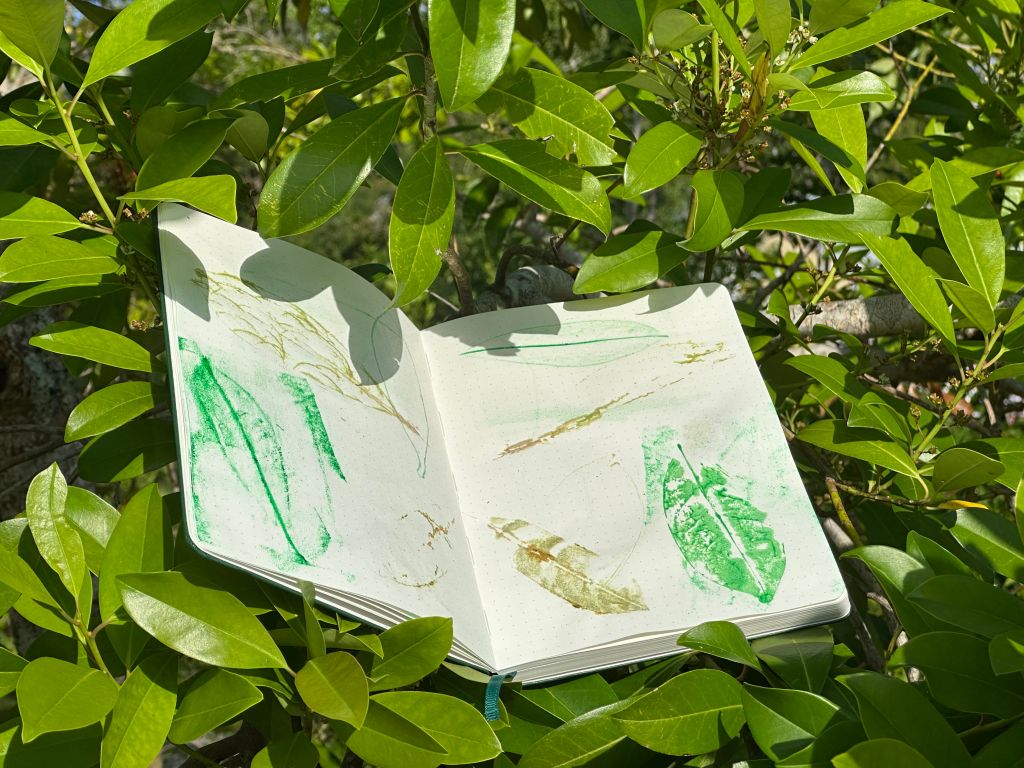
Now that we had some color on our page, we were ready to add some information.
Arbor Day timeline
The use of a timeline can be powerful in capturing information about the natural world, including the life cycle of a living thing.
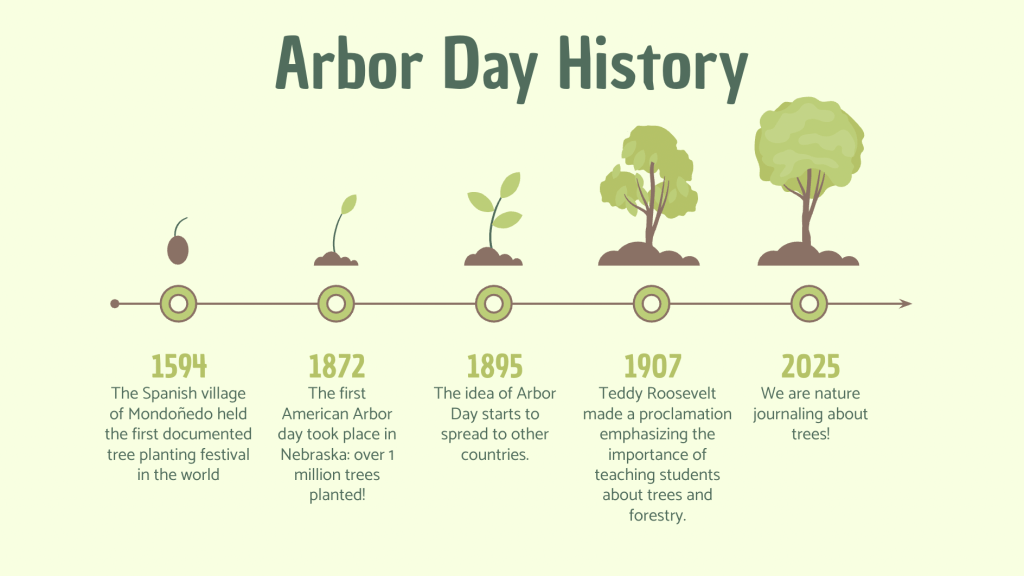
To share a little bit of information about the topic of trees and also explore ways to use timelines in our nature journal, I shared a few important dates in the history of Arbor Day, and then showed how I would put a linear timeline in my example journal spread.
On the whiteboard, I showed other ways of depicting timelines, such as a circular format, and then I gave students an opportunity to create a timeline on their page.
Then it was time for more art!
Blind Contour Drawing
While I have a strong background in writing, I am still very much a beginner when it comes to drawing. In preparation for this class, I watched John Muir Laws’ online 2-hour class “Learn to Draw Happy Little Trees.”

There was a LOT of wonderful information, but since my class time is limited to only 1 hour, I decided the best activity to pull from his class would be blind contour drawing.
I had a few simple illustrations of trees on my powerpoint slides, and I asked my students to draw some of them while looking only at the reference image and not looking at their hand or paper.
Then it was time to let the students take what they had learned and apply it to a fresh new entry.
Create your own tree entry
I sent participants outside to choose a tree to focus their entry on. They were encouraged to use some of the strategies we’d learned about, and potentially use some of the resources provided to research a little more about their tree to add information to their page.
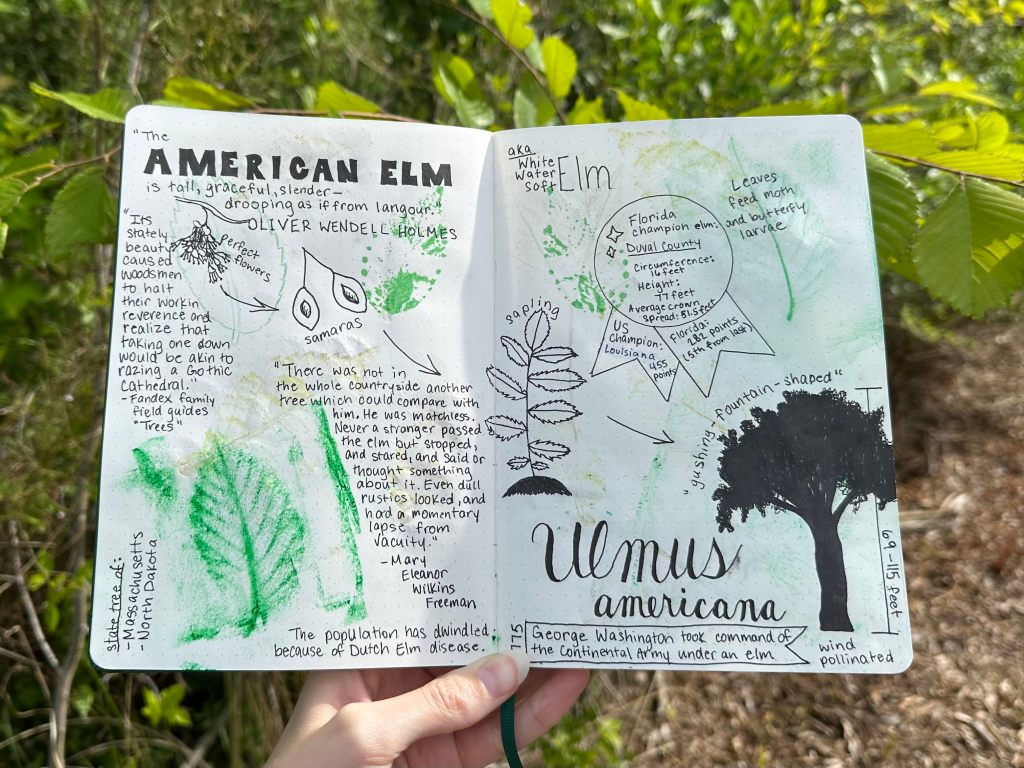
The students were also free to incorporate anything else from the prompt list I provided, or to address one of the additional prompts in a separate entry.
Additional tree prompts
Many of these prompts were gathered from Wild Wonder Foundation and Daily Skill Building.
- Tree Timeline: Make a timeline that shows the different points through a tree’s life cycle.
- Leaf Tracing: Get a leaf, and trace around the edge to capture the shape in your journal.
- Leaf Rubbing: Put a leaf under your page and rub an unwrapped crayon or pastel onto the page to capture the texture of the leaf.
- Leaf Pounding: Put a leaf on your page and cover it with another piece of paper. Use a hammer or mallet to pound onto the leaf through the paper. This should release the pigment of the leaf onto the page. Experiment with different types of leaves or even flowers.
- Painted Leaf Print: Cover one side of a leaf with paint. Press the leaf, paint side down, onto your page to transfer the paint.
- Draw a blind contour drawing of a tree crown – look at the outline of a tree in a photo or in real life, and draw the shape of the tree without looking at your hand or paper.
- Zoom In, Zoom Out: Draw a tree (or its parts) in three scales: magnified, life size, and distant. Reflect on the kinds of observations you made at each level.
- Write a letter to a tree.
- Write a short story about a tree, OR imagine you are a tree and write a short story from that tree’s perspective.
- Write a poem about a tree.
- Create a calligram about a tree.
- Choose a tree and give it a name. What do you think its personality would be like? Write a dialogue between you and the tree.
- Imagine a tree could talk and share its experiences over the years. Write a letter from an ancient tree to a young sapling.
- Research a specific type of tree in your area. Write about its importance to the local environment and any threats it might be facing.
- Imagine you’re a tree activist. Write a speech convincing others to protect and care for our forests.
- Out the Window: Draw a tree you can see out of your windows.
- One-line Tree: Draw a tree using one single stroke–don’t lift your drawing utensil until you complete the entire drawing!
- Go Monochrome: Sketch a tree using values of only one color, or play with using a non-local color.
- Leaf Study: Focus deeply on a single leaf, or make a comparison or montage.
- Look closely at a tree’s bark. What does it feel like? Can you find any insects or small creatures living there? Create a journal entry about your observations and discoveries.
- Draw a tree in different seasons – spring, summer, autumn, and winter.
- Bark! Bark!: Focus on the delicious textures of bark. Consider making a texture map or bark rubbing.
- Choose a tree and study its leaves, branches, and surroundings. Write a “tree detective” report, detailing your findings about the tree’s species, age, and health.
- Old and wise: Journal an old tree in your neighborhood.
- New to me: Draw a tree you’ve never seen before, identify it, learn and note down both the common and botanical names.
- Get to the root of it: Sketch, question, measure the root system of a tree.
- Up in the canopy: Observe a tree by looking up into the canopy. Draw slowly, noting the patterns of sun and shade as they move and change.
- The Snuggle is real: Journal two trees growing tightly together.
- Critters: Draw a tree and note all the interactions with birds, insects, animals, and humans.
- Twig Drawing: Draw trees, leaves, and branches using a twig as a paintbrush/pen
- Nursery Rhymes: Go to a local nursery to draw trees for sale along with the tree shoppers. Write poems or haiku to go with your sketches.
- Scent-sational: Journal the scents and smells of a tree.
- Stick Figures: Diagram a handful of trees very simply, making basic line drawings of the branching structure.
- Damage: Journal a tree showing damage or injury such as cuts, weeps, or seeps. Is there a tree who has suffered bad pruning?
- Trees and People: Draw people interacting with trees, or explore how how people set the scale for a tree. You might sit at a cafe and draw the trees nearby, including the people.
- Beauty Break: Visit a local garden or park, and journal the most beautiful tree you see. What makes it beautiful to you?
- In Context: Focus on everything surrounding a tree. Is it growing in a concrete jungle? A field? A forest? How does the tree contrast with the human-built environment?
- Throwing Shade: Use shading and value to show volume in a tree.
- De Colores: Make a tree color chart of the different colors you see when drawing trees. Experiment with novel ways to organize the chart. A pie chart? A grid? A rainbow?
- Lean on Me: How does wind affect trees? Find a windy area and journal the lean of the trees.
- Tell a Story: Draw a tree concentrating on visual storytelling. What else can you include in the tree’s setting that tells a story about that tree?
- Arboreus Maximus: Draw the biggest tree in your neighborhood. For a mega-challenge, draw the biggest tree in your town, city, or region!
 Ecology Ellie